
Free advice from our biologist and nutritionist. Learn More

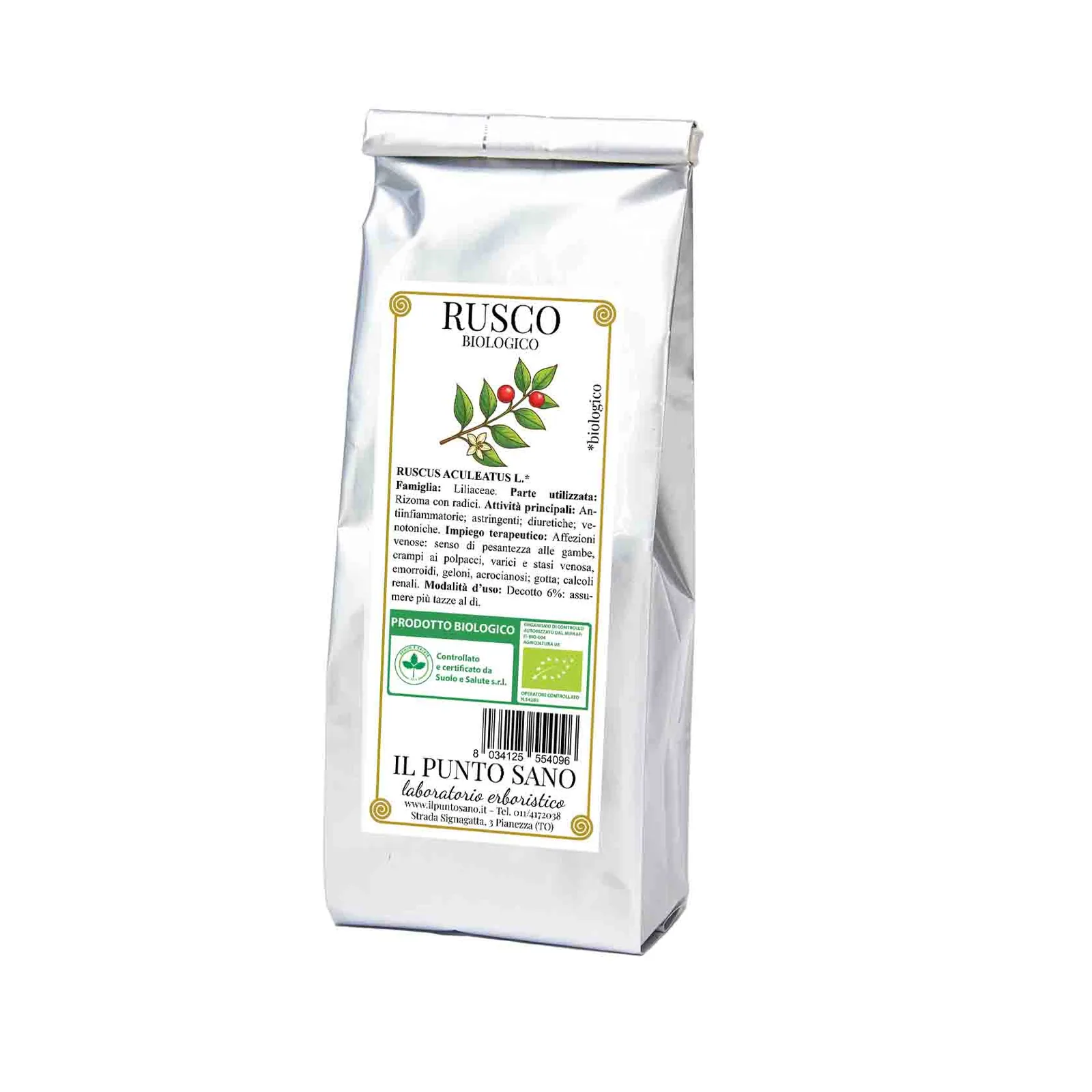



Organic Butcher's Broom Herbal Tea
8,50 €
60 g
Butcher’s broom for a routine dedicated to your legs.
Butcher’s Broom by Il Punto Sano provides rhizome and roots of a plant traditionally associated with microcirculation and venous circulation.
- ✓ Butcher’s broom rhizome and roots.
- ✓ A traditional plant for microcirculation and venous circulation.
- ✓ Full preparation and directions always available.
- Free shipping in Italy on orders of €70 or more
- Prepared within 1 working day + GLS transit of 2–4 working days
- Buy directly from our laboratory
- Free product advice from our biologist and nutritionist
Full product information: features, ingredients and directions for use.


Organic Butcher’s Broom: rhizome and roots for microcirculation, heavy legs and venous circulation
Organic Butcher’s Broom by Il Punto Sano, also known as Ruscus, is a certified organic herbal tea made with rhizome and roots of Ruscus aculeatus L., an evergreen plant traditionally used in preparations for microcirculation, venous circulation and heavy legs.
Its current botanical family is Asparagaceae. Traditional herbal profiles may still place it in Liliaceae or use the historical family Ruscaceae. Both historical names are retained here for continuity with herbal literature alongside its current classification.
Butcher’s Broom rhizome and roots contain steroidal saponins, including ruscogenin and neoruscogenin, alongside flavonoids, phytosterols and characteristic botanical compounds. Its main wellbeing applications are: microcirculatory function, heavy legs, venous circulatory function and haemorrhoidal plexus function.
Why choose Organic Butcher’s Broom by Il Punto Sano
- Certified organic rhizome and roots of Ruscus aculeatus, traditionally known as Butcher’s Broom.
- Supports microcirculatory function, particularly in relation to heavy legs.
- Supports venous circulatory function, as physiological support rather than treatment.
- Supports haemorrhoidal plexus function, without replacing medical assessment of haemorrhoidal symptoms.
- A classic plant in traditional venotonic blends, often combined with Red Vine, Bilberry, Horse Chestnut, Witch Hazel, Centella and Sweet Clover.
- Contains ruscogenins and steroidal saponins, characteristic rhizome constituents.
- Traditional astringent and drainage profile, to be understood with appropriate care.
- Selected, certified organic raw material, without artificial flavourings, colourings or preservatives.
Ruscus aculeatus: the botany of Butcher’s Broom
Ruscus aculeatus L., known as Butcher’s Broom, Ruscus, Butcher’s broom or Fragon épineux, is a rhizomatous evergreen typical of the Mediterranean and shady, calcareous woodland habitats.
It has stiff, branched stems with flattened, pointed structures called cladodes, often mistaken for leaves. Small greenish flowers appear at their centres and develop into characteristic red berries, decorative but not used in this preparation.
The part used in herbal practice is the rhizome with roots, also called Rusci rhizoma. This underground part is traditionally associated with microcirculation, venous circulation and haemorrhoidal plexus function.
At a glance
Organic Butcher’s Broom by Il Punto Sano is a certified organic herbal tea made with rhizome and roots of Ruscus aculeatus, traditionally used for microcirculatory function, heavy legs, venous circulation and haemorrhoidal plexus function.
Butcher’s Broom and traditional use
Butcher’s Broom is one of the best-known plants in venous-circulation herbal preparations. Its Italian name “Pungitopo” reflects the traditional use of its prickly branches to protect food stores from rodents.
The rhizome and roots have historically been used in teas and extracts for heavy legs, microcirculation, the haemorrhoidal plexus and venous tone.
Its modern role is physiological support for microcirculation, venous circulation and heavy legs, rather than treatment of varicose veins, venous insufficiency, thrombosis, haemorrhoids, chilblains or diagnosed vascular disorders.
Butcher’s Broom and microcirculatory function
Its principal wellbeing application is microcirculatory function, particularly in relation to heavy legs. This makes it suited to teas for venous wellbeing, tired legs and circulatory routines.
Microcirculation support should be understood physiologically. The tea supports heavy-leg routines and microcirculatory function; it does not promise to repair broken capillaries or treat varicose veins, pathological swelling, cellulite or clinical venous insufficiency.
For a broader blend, Butcher’s Broom may be combined with Red Vine, Bilberry, Centella, Sweet Clover, Horse Chestnut, Witch Hazel, Ginkgo or Horsetail, always assessing each ingredient’s warnings.
Butcher’s Broom and heavy legs
Heavy legs are a particularly relevant context for Butcher’s Broom. It may suit routines for people who stand or sit for many hours, feel tired legs at the end of the day or want a traditional venotonic herbal tea.
Herbal support is more useful alongside regular activity, active breaks, hydration, balanced eating and, where advised, compression hosiery or professional guidance.
Sudden swelling in one leg, intense pain, redness, warmth, breathing difficulty or a suspected acute circulatory problem require prompt medical assessment.
Butcher’s Broom and venous circulation
Butcher’s Broom is traditionally used for venous circulatory function. This refers to physiological support.
Venous-circulation support is not treatment for chronic venous insufficiency, phlebitis, thrombosis, varicose veins, significant oedema or pathological venous stasis.
Prominent veins, pain, persistent swelling, skin colour changes, skin lesions, ulcers or significant symptoms warrant medical assessment.
Butcher’s Broom and the haemorrhoidal plexus
Butcher’s Broom is also described for haemorrhoidal plexus function. This supportive role requires careful interpretation.
It supports venous circulation and haemorrhoidal plexus function, rather than promising to “cure haemorrhoids”, “stop bleeding” or “resolve pain”.
Rectal bleeding, significant pain, lumps, intense itching, discharge, worsening symptoms, suspected anaemia or recurrent complaints require medical or proctological assessment.
Butcher’s Broom and varicose veins
Varicose veins appear in historical descriptions, but are not a direct indication for this tea: they are a venous condition that may require specialist assessment.
Butcher’s Broom offers microcirculatory and venous-function support, particularly for heavy legs.
With significant varicose veins, pain, oedema, skin changes or worsening symptoms, the tea does not replace medical advice.
Butcher’s Broom and venous stasis
Venous stasis is a clinical term indicating altered venous circulation and is not the primary application of this product.
Its role remains physiological support for venous function, microcirculation and heavy legs.
Significant venous stasis, oedema, darkened or hardened skin, severe itching, lesions or ulcers require medical assessment.
Butcher’s Broom and calf cramps
Traditional descriptions mention calf cramps. This requires care because cramps may have muscular, vascular, neurological, metabolic or medicine-related causes, or relate to dehydration and minerals.
Butcher’s Broom is not a cramp treatment; it supports microcirculatory function and routines for heavy legs.
Frequent, night-time or painful cramps, especially with swelling, tingling, weakness, pain on walking or altered sensation, need medical investigation.
Butcher’s Broom, chilblains and acrocyanosis
Chilblains and acrocyanosis appear in traditional references associated with peripheral circulation, but are not direct product indications.
Its role is microcirculatory-function support, without a promise of effects on chilblains, cold fingers, cyanosis, peripheral vascular problems or skin colour changes.
Pain, ulceration, persistently bluish fingers, loss of sensation, wounds or worsening with cold require medical assessment.
Butcher’s Broom and traditional venotonic activity
The term venotonic is widely used in herbal practice for Butcher’s Broom. It describes traditional context, while its principal role remains venous circulatory function.
This expresses the plant’s value without suggesting a medicine for venous disease.
Butcher’s Broom complements a routine of activity, active breaks, weight management, hydration and attention to prolonged postures.
Butcher’s Broom and astringent activity
Traditional descriptions also mention astringency. This is secondary context, particularly in relation to historical haemorrhoidal plexus and mucosal uses.
Microcirculation and venous circulation remain the main focus, rather than astringency.
Astringency should not be interpreted as a promise concerning bleeding, fissures, inflammation, ulcers or lesions.
Butcher’s Broom and fluid drainage
Traditional descriptions mention diuretic activity. This remains secondary context: the plant’s main profile concerns venous circulation and microcirculation.
For drainage-focused routines, consider broader blends with Birch, Nettle, Horsetail, Mouse-ear Hawkweed, Dandelion, Java Tea or Couch Grass.
Drainage teas need careful assessment with kidney or heart disease, significant oedema, diuretics, lithium or medical instructions to manage fluid intake.
Butcher’s Broom, gout and kidney stones
Gout and kidney stones appear in historical descriptions, but are not product indications: these medical conditions require specific diagnosis and management.
Butcher’s broom is chiefly valued for microcirculation, venous circulation and haemorrhoidal plexus function. Its associations with gout and urinary stones are historical references, rather than established uses of this tea.
Acute joint pain, swelling, renal colic, blood in the urine, lower-back pain, fever or difficulty urinating require medical assessment.
Butcher’s Broom and anti-inflammatory activity
Traditional descriptions mention anti-inflammatory activity. This should not be interpreted as treatment of inflammation or pain from this product.
Its role is support for microcirculatory, venous and haemorrhoidal plexus function.
This recognises the plant’s value without promising pharmacological effects.
Butcher’s Broom and blood pressure
Care is needed with uncontrolled high blood pressure or cardiovascular treatment. Its traditional venous-tone and microcirculatory profile makes continuous unsupervised use inappropriate in significant cardiovascular conditions.
If taking antihypertensives, vasoconstrictors, anticoagulants, antiplatelets, circulation medicines or cardiovascular treatment, seek advice from a doctor or pharmacist.
With palpitations, very high blood pressure, chest pain, significant swelling or breathing difficulty, the tea is not an appropriate intervention.
Butcher’s Broom in blends for heavy legs
Butcher’s Broom is a classic heavy-leg blend ingredient. It may be combined with Red Vine, Bilberry, Centella, Sweet Clover, Horse Chestnut, Witch Hazel, Ginkgo, Horsetail and Nettle.
Its role is microcirculatory and venous-function support; other herbs may complement this with flavonoids, antioxidants, drainage or connective-tissue support.
Circulatory blends require care with anticoagulants, antiplatelets, diagnosed venous disease, bleeding, planned surgery or pregnancy.
Butcher’s Broom in haemorrhoidal plexus blends
In blends for the haemorrhoidal plexus, Butcher’s Broom may be combined with Witch Hazel, Horse Chestnut, Red Vine, Sweet Clover, Cypress, Yarrow, Mallow or Psyllium, depending on the preparation’s form and purpose.
These support venous and haemorrhoidal plexus function, rather than promising to “cure haemorrhoids”, “stop bleeding” or “eliminate pain”.
Blood in stools, intense pain, persistent lumps, discharge, anaemia, weight loss or recurrent symptoms require medical assessment.
Characteristic constituents of Butcher’s Broom
The rhizome and roots of Ruscus aculeatus contain a phytocomplex characterised by steroidal saponins, ruscogenin, neoruscogenin, ruscosides, flavonoids, phytosterols, triterpenes, phenolic compounds, mineral salts and characteristic botanical substances.
Ruscogenins are among the herbal material’s defining constituents and contribute to its identity in microcirculation and venous-circulation preparations.
Raw-material quality depends on correct botanical identification, rhizome cleanliness, a regular cut, appropriate drying, absence of mould or stale notes and storage away from light, air and moisture.
Butcher’s Broom decoction: aromatic profile
Butcher’s Broom decoction has a root-like, earthy, woody, lightly bitter, astringent herbal taste. It is not a sweet or fruity tea: it has the dry, distinctive character typical of roots and rhizomes.
For a more pleasant taste, it may be combined with Bilberry, Rosehip, Sweet Orange peel, Liquorice, Mint, Fennel or Lemon Balm.
In venous-support blends, aromatic or fruity herbs can balance the flavour while Butcher’s Broom remains the microcirculatory and venous-support base.
Il Punto Sano quality: certified organic Butcher’s Broom, selected rhizome and a herbal cut
Il Punto Sano herbs begin with carefully selected certified organic raw materials, with attention to botanical quality, freshness, cleanliness, cut and performance in preparation.
Organic Butcher’s Broom rhizome and roots are selected for correct botanical identification, a clean cut, absence of impurities and overall quality. Good raw material has a clean smell, no mould or stale notes and appropriate drying.
We use no artificial flavourings, colourings or preservatives. The taste comes from the organic rhizome of Ruscus aculeatus: earthy, astringent and naturally herbal. The packaging protects it from light, air and moisture, helping preserve quality and characteristics over time.
Who is Organic Butcher’s Broom Rhizome and Roots for?
Organic Butcher’s Broom by Il Punto Sano is intended for adults seeking a certified organic herbal tea for:
- microcirculatory function;
- heavy legs;
- venous circulatory function;
- haemorrhoidal plexus function;
- traditional venotonic and circulatory blends;
- routines for legs tired by prolonged standing or sitting;
- combinations with Red Vine, Bilberry, Centella, Horse Chestnut, Witch Hazel, Sweet Clover or Ginkgo;
- a certified organic plant with a traditional venous profile.
Herbal profile
Ruscus aculeatus L. – certified organic rhizome with roots
| Botanical name | Ruscus aculeatus L. |
| Common name | Ruscus, Butcher’s Broom, Rusci rhizoma |
| Family | Asparagaceae; historically also classified in Liliaceae or Ruscaceae |
| Plant part used | Dried, cut rhizome with roots; rhizoma/radix |
| Quality | Certified organic raw material |
| Characteristic constituents | Steroidal saponins, ruscogenin, neoruscogenin, ruscosides, flavonoids, phytosterols, triterpenes, phenolic compounds and mineral salts |
| Traditional profile | Microcirculatory function, heavy legs, venous circulatory function and haemorrhoidal plexus function; varicose veins, venous stasis, haemorrhoids, chilblains, acrocyanosis, gout and kidney stones are traditional references requiring careful interpretation |
| Decoction taste | Root-like, earthy, woody, lightly bitter, astringent and herbal |
Directions for use
6% decoction: prepare a decoction following the label directions. As a traditional reference, a 6% decoction corresponds to approximately 6 g plant material per 100 ml water. Bring to the boil, simmer briefly, then turn off the heat and leave covered to rest. Strain thoroughly. Drink several cups daily only where permitted by the directions and well tolerated. For regular use, particularly with medicines or circulatory complaints, seek advice from a doctor or pharmacist.
Herbal advice
Butcher’s Broom suits blends for microcirculation, heavy legs and venous circulation. It combines well with Red Vine, Bilberry, Centella, Horse Chestnut, Witch Hazel, Sweet Clover and Ginkgo. For a more pleasant flavour, balance it with Rosehip, Bilberry, Liquorice, Mint or Sweet Orange peel.
Warnings: Do not exceed recommended amounts. Keep out of reach of children. Intended for adults. Do not use with allergy or hypersensitivity to Butcher’s Broom, Ruscus, Asparagaceae, the historically used Liliaceae or Ruscaceae families, or any constituent. Avoid during pregnancy, breastfeeding and childhood unless advised otherwise by a doctor. Use carefully with uncontrolled hypertension, cardiovascular or kidney disease, significant oedema, diagnosed venous insufficiency, significant varicose veins, thrombosis or thrombotic risk, bleeding haemorrhoids, liver disease, anticoagulants, antiplatelets, antihypertensives, vasoconstrictors, diuretics, lithium, circulation medicines, planned surgery or particular medical circumstances. Do not use to treat varicose veins, venous stasis, phlebitis, thrombosis, haemorrhoids, rectal bleeding, chilblains, acrocyanosis, gout, kidney stones, renal colic, oedema, pathological cramps or diagnosed conditions. Promptly consult a doctor for sudden leg swelling, intense calf pain, redness, warmth, breathing difficulty, chest pain, rectal bleeding, blood in stools, significant anal pain, renal colic, blood in the urine, fever, worsening symptoms or allergic reactions. Information on this website is provided for herbal and informational purposes and does not replace medical advice.
Frequently asked questions
Which part of the plant is used?
The plant part listed in the product information is: Dried, cut rhizome with roots; rhizoma/radix.
Can I ask for advice before choosing?
Yes. Ask our laboratory for free product advice on WhatsApp at +39 334 883 6323.
Ask for advice on WhatsApp


 English (UK)
 Italiano
Reviews
There are no reviews yet.