
Free advice from our biologist and nutritionist. Learn More

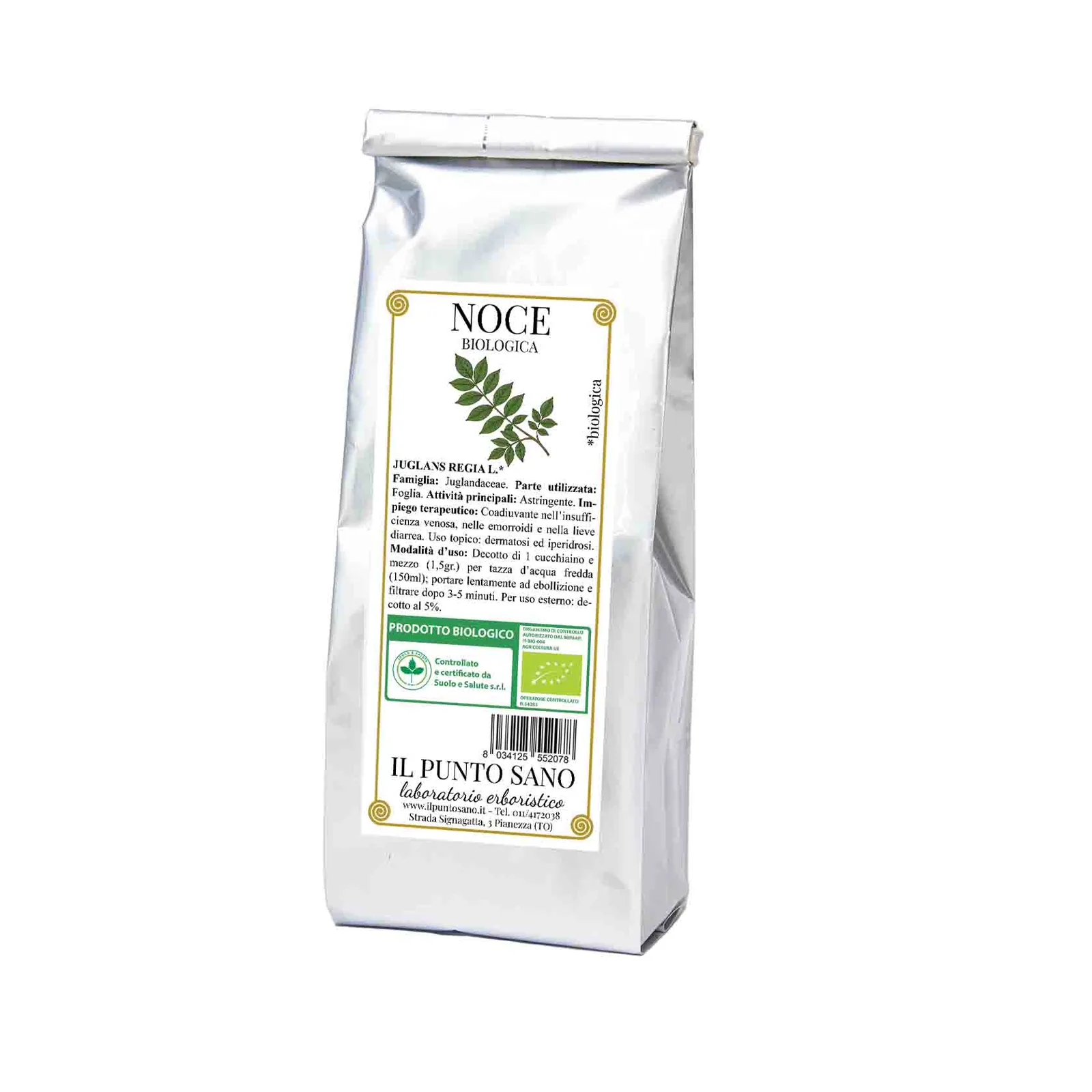



Organic Walnut Leaf Herbal Tea
7,30 €
60 g
Walnut leaves in herbal tradition.
Il Punto Sano Walnut offers walnut leaves characterised by tannins, to be used according to the directions.
- ✓ Walnut leaves.
- ✓ Tannin-rich herbal material, to be used according to the directions.
- ✓ Complete preparation and directions always available.
- Free shipping in Italy on orders of €70 or more
- Prepared within 1 working day + GLS transit of 2–4 working days
- Buy directly from our laboratory
- Free product advice from our biologist and nutritionist
The complete product information: features, composition and directions for use.


Organic Walnut: astringent leaves for the bowel, skin and local sweating
Il Punto Sano Organic Walnut is a certified organic herbal tea made from the leaves of Juglans regia L., a tree belonging to the Juglandaceae. Walnut has a rich food and herbal tradition, known particularly for its fruit, green husk and leaves rich in tannins and polyphenols.
Walnut leaves are traditionally used for their astringent profile in internal preparations for normal stool consistency and external preparations for skin wellbeing and local sweating. Their taste is herbal, tannic and slightly bitter, typical of tannin-rich herbal material.
Why choose Il Punto Sano Organic Walnut
- Certified organic leaves of Juglans regia, a herbal tree in the Juglandaceae family.
- Traditional astringent profile associated with natural tannins and polyphenols.
- Support for bowel regularity as physiological support requiring careful use.
- Useful for normal stool consistency, rather than diarrhoea treatment.
- Traditional external use on intact skin as a thoroughly strained, lukewarm decoction.
- Traditionally used for local sweating, particularly hand and foot washes or compresses.
- Contains tannins, flavonoids, phenolic acids and juglone, characteristic Walnut leaf constituents.
- Selected, certified organic raw material, without artificial flavourings, colourings or preservatives.
Juglans regia: Walnut botany
Juglans regia L., known as Common Walnut, European Walnut, Walnut or Common walnut, is a large deciduous tree belonging to the Juglandaceae.
It has a sturdy trunk, broad crown, compound odd-pinnate leaves, male flowers in hanging catkins and less conspicuous female flowers. The fruit is a drupe with a green outer husk and an edible seed commonly called the walnut.
The part used in this preparation is the dried, cut leaf. The leaves have a green, mildly aromatic fragrance, tannic taste and traditional astringent use.
At a glance
Il Punto Sano Organic Walnut is a certified organic herbal tea made from the leaves of Juglans regia, traditionally used for an astringent profile, normal stool consistency, external skin wellbeing and local sweat regulation.
Walnut and traditional use
Walnut holds an important place in Mediterranean and European tradition. Different parts had different uses: the seed as food, the husk for dyes and liqueurs, bark and leaves in folk and herbal practice.
The leaf’s tannins and astringency made it interesting both in internal bowel preparations and external uses on intact skin.
Traditional use is distinct from medical treatment: Walnut leaf is not a cure for venous insufficiency, haemorrhoids, persistent diarrhoea, skin diseases, skin infections or pathological hyperhidrosis.
Walnut leaves and astringent action
Astringency is the leaves’ most characteristic profile, mainly associated with natural tannins, plant compounds giving the infusion a dry, tannic, slightly bitter taste.
Its role is traditional astringency and normal stool consistency, rather than a diarrhoea cure or antidiarrhoeal treatment.
Persistent diarrhoea, fever, blood in stools, dehydration, significant abdominal pain or symptoms in children require medical advice.
Walnut leaves and bowel transit
Walnut leaves can be included in routines focused on bowel regularity, particularly when a tannic, astringent tea is wanted.
Traditional mild-diarrhoea references mean normal stool consistency and astringent use here, rather than treatment for diarrhoea or intestinal infections.
Combine with Agrimony, Tormentil, Bilberry fruits, Raspberry leaves, Chamomile or Mallow, according to desired profile and individual circumstances.
Walnut and traditional mild-diarrhoea references
Traditional accounts mention mild diarrhoea, but this is not an antidiarrhoeal product. Diarrhoea can have dietary, infectious, medicine-related, inflammatory or functional causes.
Walnut leaves are traditionally astringent herbal material supporting normal stool consistency and bowel regularity.
Diarrhoea lasting over 2–3 days, intense diarrhoea or symptoms with fever, vomiting, blood, mucus, dehydration or significant pain require medical assessment.
Walnut and traditional external use
One of Walnut leaf’s best-established areas is traditional external use. A thoroughly strained, lukewarm decoction is traditionally used for washes, compresses or foot baths on intact skin.
The leaf is particularly associated with skin wellbeing and local sweating of hands and feet.
External use is distinct from drinking it and is not treatment for dermatitis, significant eczema, fungal infections, infections, wounds, ulcers, open lesions or pathological hyperhidrosis.
Walnut leaves for intact skin
Walnut leaf decoction may be used externally on intact skin as a traditional astringent botanical preparation.
Use for local washing, brief compresses or foot baths only after thorough straining and cooling to lukewarm.
Broken skin, significant dermatitis, persistent itching, skin infection, discharge, marked redness or worsening symptoms require medical or dermatological advice.
Walnut leaves and local sweating
Walnut leaf also has a tradition of external use for local sweating. A 5% decoction is traditionally used in hand and foot washes or foot baths when an astringent preparation is wanted.
Its role is traditional support for regulating local sweating, not treatment for pathological hyperhidrosis.
Very intense, sudden, nocturnal or generalised sweating, or that with fever, weight loss, palpitations, intense anxiety or endocrine disorders, requires medical assessment.
Walnut and traditional skin-disease references
Older accounts mention dermatoses, a broad term for skin conditions with inflammatory, allergic, infectious, autoimmune or irritant causes.
This is historical background rather than a use indication. Here the role is traditional external application to intact skin and astringent skin-wellbeing support.
Walnut leaf is not a treatment for dermatitis, psoriasis, eczema, fungal infections, infections, wounds or skin lesions.
Walnut, venous insufficiency and haemorrhoid references
Traditional accounts mention venous insufficiency and haemorrhoids, conditions that may require medical assessment and specific treatment.
Walnut leaf is traditionally astringent but not a treatment for venous insufficiency, haemorrhoids, bleeding, varicose veins or haemorrhoidal-plexus disorders.
Butcher’s Broom, Witch Hazel, Red Vine, Sweet Clover, Horse Chestnut, Centella and Bilberry are more specifically associated with venous and haemorrhoidal-plexus wellbeing. Walnut leaf may remain a secondary astringent component rather than the main focus.
Walnut and topical use: 5% decoction
Traditional external directions specify a 5% decoction. This is more concentrated than drinking tea and intended only externally on intact skin.
Strain thoroughly, allow to cool to lukewarm and use the same day, avoiding prolonged storage.
Do not apply external decoction to open wounds, sensitive mucous membranes, eyes, very irritated skin or lesions. Stop if burning, itching or redness occurs.
Walnut leaves and tannins
Tannins are an important leaf fraction, responsible for astringent taste and the infusion’s dry feel.
Herbal practice traditionally uses tannin-rich plants for astringency in the bowel and external preparations on intact skin.
Excessive or prolonged use may be unsuitable with a sensitive stomach, constipation, gastritis or medication. Keep use moderate and intermittent.
Walnut leaves and juglone
Walnut leaf also contains juglone, a naphthoquinone characteristic of the genus Juglans alongside tannins, flavonoids and phenolic acids.
Juglone is also known for walnut’s ecological role in interacting with its surroundings. Here it is a characteristic constituent, rather than evidence of antibacterial, antifungal or therapeutic effects.
Active compounds underline the importance of thoughtful use, avoiding inappropriate, excessive or prolonged use without professional advice.
Walnut and children
Traditional accounts do not specify child use, but mention mild diarrhoea and external application. This product is intended for adults unless a doctor or paediatrician advises otherwise.
Children’s diarrhoea needs particular care because dehydration may develop faster. Do not manage a child’s diarrhoea, fever, vomiting or abdominal pain with tea without paediatric advice.
External use in children also requires care, particularly with sensitive skin, allergies or dermatitis.
Walnut leaves in bowel blends
Use when a tannic, astringent profile is wanted, with Agrimony, Tormentil, Bilberry fruits, Raspberry leaves, Chamomile or Mallow.
Its principal role is traditional astringency, not antidiarrhoeal treatment. Formulas must consider individual circumstances and symptom duration.
For gentler blends, balance with emollient Mallow or Marshmallow, or aromatic Fennel and Lemon Balm.
Walnut leaves in external preparations
For external use, combine with traditional astringent or emollient plants such as Witch Hazel, Agrimony, Sage, Mallow, Chamomile or Calendula according to purpose.
For hands and feet, use decoction in local washes or foot baths. On intact skin, use a brief, thoroughly strained compress.
External use should remain careful, not replace dermatological products and avoid lesions, mucous membranes or very irritated areas.
Characteristic Walnut leaf constituents
The leaves of Juglans regia contain a phytocomplex characterised by tannins, flavonoids, phenolic acids, gallic acid, ellagic acid, naphthoquinone derivatives such as juglone, traces of essential oil, minerals and aromatic compounds.
Tannins contribute astringency. Flavonoids and phenolic acids complete the leaf’s polyphenolic profile, while juglone is characteristic of the genus Juglans.
Quality depends on correct identification, timely leaf harvest, gentle drying, natural colour, no mould, clean cut and storage away from light, air and moisture.
Walnut leaf tea’s aromatic profile
Walnut leaf tea tastes herbal, tannic, slightly bitter, dry, green and gently woody. Its character is bold and distinctly herbal rather than sweet or floral.
The infusion may be yellow-brown or greenish-brown, depending on amount, decoction time and leaf quality.
It pairs well with Agrimony, Tormentil, Bilberry fruits, Raspberry leaves, Mallow, Chamomile, Marshmallow, Fennel, Lemon Balm, Sage and Witch Hazel.
Il Punto Sano quality: certified organic Walnut, selected leaves and herbal cut
Il Punto Sano herbs start with carefully selected certified organic materials, with attention to botanical quality, freshness, natural colour, fragrance, herbal cut and infusion performance.
Organic Walnut leaves are selected for correct identification, clean cut, natural colour and overall quality. Good material has a clean green aroma, no mould or stale notes and proper drying.
We use no artificial flavourings, colourings or preservatives. The taste comes from the organic leaves of Juglans regia: herbal, tannic and naturally botanical. The packaging protects against light, air and moisture, helping preserve quality and characteristics over time.
Who are Organic Walnut leaves for?
Il Punto Sano Organic Walnut is intended for adults seeking certified organic herbal material for:
- a traditional astringent profile;
- bowel regularity;
- normal stool consistency;
- traditional bowel blends;
- external decoctions on intact skin;
- traditional washes and foot baths;
- external regulation of local sweating;
- blends with Agrimony, Tormentil, Bilberry, Raspberry leaves, Mallow, Chamomile or Witch Hazel.
Herbal information
Juglans regia L. – certified organic leaves
| Botanical name | Juglans regia L. |
| Common name | Walnut, Common Walnut, European Walnut, Walnut Leaf |
| Family | Juglandaceae |
| Part used | Dried, cut leaves; folium |
| Quality | Certified organic raw material |
| Characteristic constituents | Tannins, flavonoids, phenolic acids, gallic acid, ellagic acid, juglone, naphthoquinone derivatives, traces of essential oil, minerals and aromatic compounds |
| Traditional profile | Astringent, normal stool consistency, bowel regularity, external use on intact skin, local sweating, with dermatosis and hyperhidrosis as traditional references requiring care |
| Infusion taste | Herbal, tannic, slightly bitter, dry, green and gently woody |
Directions for use
Decoction for internal use: use 1 and a half teaspoons of Walnut leaves, approximately 1.5 g, for a cup of cold water measuring 150 ml. Bring slowly to the boil, simmer gently and strain after 3–5 minutes. Enjoy according to your needs and the label directions.
Traditional external use: prepare a 5% decoction, strain thoroughly, cool to lukewarm and use for washes, brief compresses or foot baths on intact skin. Avoid wounds, mucous membranes, eyes and lesions.
Herbal tip
Walnut leaf is particularly suited to traditional astringent blends and external decoctions on intact skin. For bowel transit, combine with Agrimony, Tormentil, Bilberry fruits, Raspberry leaves, Mallow or Chamomile. Externally, pair with Witch Hazel, Sage, Mallow and Calendula.
Warnings: Do not exceed the recommended amounts. Keep out of the reach of children. Intended for adults. Do not use if allergic or hypersensitive to Walnut, Juglandaceae, tree nuts or any component. During pregnancy, breastfeeding or childhood, seek medical advice before use. Use carefully with significant food allergies, tree-nut allergy, severe constipation, gastritis, ulcers, irritable bowel, gastrointestinal disease, persistent diarrhoea, medication or particular medical conditions. Do not use this tea to treat significant diarrhoea, intestinal infections, venous insufficiency, haemorrhoids, bleeding, varicose veins, skin diseases, pathological hyperhidrosis, skin infections, wounds, dermatitis, significant eczema or diagnosed conditions. Externally use only on intact skin, strain thoroughly and stop if burning, itching, redness or irritation occurs. Avoid open wounds, mucous membranes, eyes and skin lesions. Diarrhoea lasting over 2–3 days, fever, blood in stools, dehydration, significant abdominal pain, rectal bleeding, painful haemorrhoids, sudden or generalised sweating, skin lesions, infections, worsening symptoms or allergic reactions require medical advice. This website’s information is provided for informational and herbal purposes and does not replace medical advice.
Frequently asked questions
Which part of the plant is used?
The plant part listed in the product information is: Dried, cut leaves; folium.
How should I prepare this herbal tea?
Decoction for internal use: use 1 and a half teaspoons of Walnut leaves , approximately 1.5 g , for a cup of cold water measuring 150 ml . Bring slowly to the boil, simmer gently and strain after 3–5 minutes . Enjoy according to your needs and the label directions. Traditional external use: prepare a 5% decoction , strain thoroughly, cool to lukewarm and use for washes, brief compresses or foot baths on intact skin. Avoid wounds, mucous membranes, eyes and lesions.


 English (UK)
 Italiano
Reviews
There are no reviews yet.