
Free advice from our biologist and nutritionist. Learn More

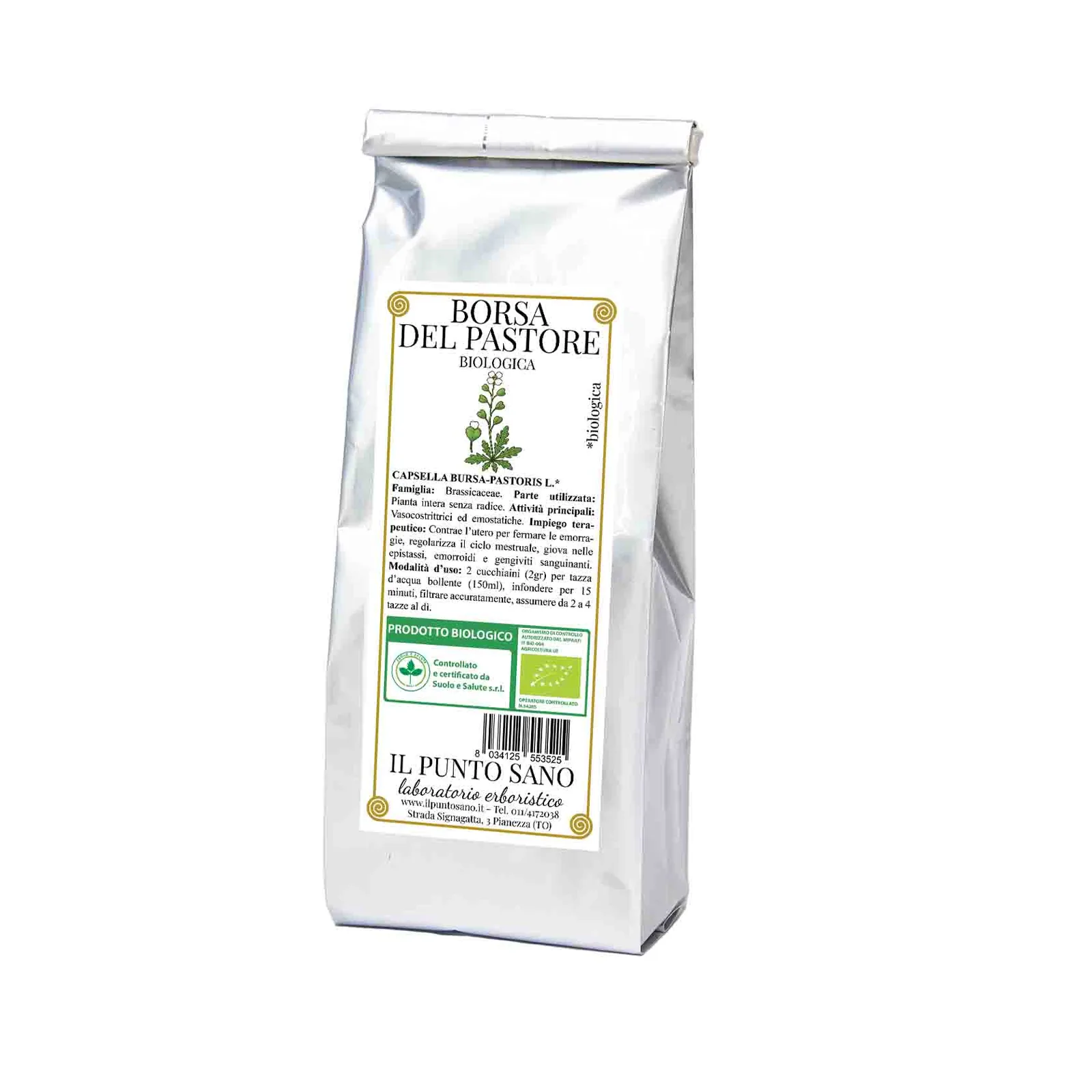



Organic Shepherd’s Purse Herbal Tea
8,00 €
70 g
A plant rooted in women’s wellbeing tradition.
Il Punto Sano Shepherd’s Purse offers shepherd’s purse aerial parts. Explore composition and limits of use before adding it to your routine.
- ✓ Shepherd’s Purse aerial parts.
- ✓ Explore composition and limits of use before adding it to your routine.
- ✓ Full preparation directions and product information are always available below.
- Free shipping in Italy on orders of €70 or more
- Prepared within 1 working day + GLS transit of 2–4 working days
- Buy directly from our laboratory
- Free product advice from our biologist and nutritionist
Full product information: features, composition and directions for use.


Capsella bursa-pastoris: a traditional tea for the menstrual cycle, microcirculation and venous wellbeing
Il Punto Sano Capsella bursa-pastoris is a medicinal herbal tea made with whole plant without root of Capsella bursa-pastoris L., a species in the Brassicaceae family, traditionally used in herbal approaches to normal menstrual-cycle physiology, microcirculatory wellbeing and tissue tone.
Commonly known as Shepherd’s purse, Capsella is a small wild plant widespread in fields, meadows, paths and uncultivated ground. Its small triangular fruits resemble old shepherds’ bags, giving the plant its name.
European herbal tradition describes its astringent, vasoconstricting and traditionally haemostatic profile. Its everyday role is support for normal menstrual-cycle balance, small-vessel tone and mucosal wellbeing, not treatment for haemorrhage or pathological bleeding.
Why choose Il Punto Sano Capsella bursa-pastoris
- Whole plant without root of Capsella bursa-pastoris, a medicinal species in the Brassicaceae family.
- Traditionally used for menstrual-cycle physiology, particularly during heavier flow.
- Astringent and haemostatic according to folk use, requiring thoughtful, careful use.
- Supports small-vessel tone and microcirculatory wellbeing.
- Of interest in sensitive-mucosa routines, delicate gums and local fragility.
- A green, herbaceous, slightly pungent profile, typical of Brassicaceae.
- Selected raw material with a careful herbal cut, suited to infusion.
- No artificial flavourings: an authentic, natural, unsweetened taste.
Capsella bursa-pastoris: the botany of Shepherd’s Purse
Capsella bursa-pastoris L., known as Shepherd’s purse, is an annual or biennial herbaceous plant in the Brassicaceae family, alongside cabbage, mustard, rocket, watercress and horseradish.
Common and cosmopolitan, it grows in meadows, gardens, roadside margins, cultivated fields, disturbed ground and waste areas. Small in size, it has a basal leaf rosette, tiny white flowers and distinctive flattened triangular fruits.
Herbal practice uses the whole plant without root, the aerial portion harvested at the appropriate stage and dried, also known in herbal terminology as Bursae pastoris herba.
At a glance
Il Punto Sano Capsella bursa-pastoris is a medicinal tea of Shepherd’s Purse, traditionally used for the menstrual cycle, small-vessel tone, microcirculation, sensitive mucous membranes and women’s wellbeing.
Capsella and folk tradition
Capsella is unassuming but well established in European herbal tradition. Growing close to people, it became familiar in teas, decoctions and household preparations.
Traditional use mainly concerns its astringent character and association with minor bleeding. Older herbal texts record heavy menstruation, delicate mucous membranes and tissue tone.
Capsella is not a remedy for haemorrhage, significant bleeding or pathological conditions. Traditional functional use requires care and exclusion of relevant medical causes.
Capsella for the menstrual cycle and women’s wellbeing
A familiar area of traditional use is menstrual-cycle wellbeing. It relates to support during heavier flow and normal physiological balance.
The tea is not intended to stop haemorrhage or contract the uterus; these concern medical conditions requiring professional assessment. Its traditional role is support for the normal menstrual cycle and tissue tone.
Very heavy, irregular, sudden, painful, postmenopausal or pregnancy-related bleeding, or bleeding with weakness, anaemia or pelvic pain, requires medical advice before any herbal preparation.
Capsella and microcirculation
Capsella is traditionally described as vasoconstricting and haemostatic. Its everyday physiological role concerns small-vessel tone and microcirculatory wellbeing.
This makes it interesting in teas for local fragility, mucous membranes prone to irritation or an astringent botanical profile.
For broader microcirculatory blends, combine with Yarrow, Witch hazel, Horse chestnut, Bilberry, Cypress, Butcher’s broom or Gotu kola according to individual circumstances.
Capsella, nosebleeds and delicate mucous membranes
Folk tradition also records minor nosebleeds, delicate gums and bleeding-prone mucous membranes. This provides background to its role in mucosal wellbeing, small-vessel tone and traditional astringent character.
Frequent nosebleeds, regularly bleeding gums, bruising, blood in stool or urine or unexplained bleeding need medical assessment. Tea must never replace investigation of the cause.
For delicate mucous membranes, combine Capsella with Agrimony, Yarrow, Lady’s mantle, Mallow, Plantain or Witch hazel.
Capsella, haemorrhoid tradition and venous tone
Historical haemorrhoid references relate to support for local venous wellbeing, tissue tone and microcirculation. This places Capsella among traditional astringent plants for mucosal comfort.
Pain, substantial or recurrent bleeding, worsening symptoms or blood in the stool require medical assessment.
For venous and microcirculatory wellbeing, combine with Witch hazel, Butcher’s broom, Horse chestnut, Cypress, Bilberry, Gotu kola or Red vine.
Characteristic constituents of Capsella
The aerial parts of Capsella bursa-pastoris contains a phytocomplex characterised by flavonoids, phenolic acids, tannins, amines, minerals, sulphur compounds typical of Brassicaceae and substances traditionally associated with its astringent profile.
Tannins contribute the slightly astringent taste and tissue-tone tradition. Flavonoids and phenolic acids complete the phytocomplex.
Because traditional use involves sensitive areas such as menstruation and minor bleeding, follow recommended amounts and avoid prolonged use without professional advice.
The aromatic profile of Capsella tea
Capsella tea has a herbaceous, green, slightly pungent, vegetal and mildly astringent taste. Its profile recalls wild field herbs with a typical Brassicaceae note.
A simple, rustic, functional preparation rather than a sweet, fragrant tea. Gentler or floral plants can soften it.
It pairs well with Yarrow, Lady’s mantle, Agrimony, Witch hazel, Mallow, Lemon balm, Chamomile, Mint, Rosehip and Liquorice.
Il Punto Sano quality: selected plant, herbal cut and careful infusion
Il Punto Sano teas begin with careful selection of medicinal raw materials, focusing on freshness, natural fragrance, colour, cut quality and infusion performance.
Capsella is selected for correct botanical identification, clean cut and aerial-part quality. Good material retains a natural appearance, clean herbaceous scent and consistent infusion performance.
We use no artificial flavourings, colours or masking sweeteners. The authentic taste is herbaceous, vegetal and slightly astringent. The pack protects against light, air and moisture, preserving freshness and quality.
Who may consider Capsella bursa-pastoris
Il Punto Sano Capsella bursa-pastoris is intended for adults seeking a natural tea for:
- traditional normal menstrual-cycle support;
- physiologically heavier menstrual flow after medical causes have been excluded;
- microcirculatory wellbeing and small-vessel tone;
- sensitive or delicate mucous membranes;
- traditional local venous-tone support;
- an astringent European traditional plant;
- women’s or microcirculatory herbal blends;
- a simple, herbaceous, functional medicinal tea.
Herbal profile
Capsella bursa-pastoris L. – whole plant without root
| Botanical name | Capsella bursa-pastoris L. |
| Common name | Shepherd’s purse |
| Family | Brassicaceae |
| Part used | Whole plant without root |
| Characteristic constituents | Flavonoids, phenolic acids, tannins, amines, minerals and sulphur compounds typical of Brassicaceae |
| Traditional profile | Astringent, vasoconstricting, traditionally haemostatic; menstrual-cycle, microcirculation and tissue-tone support |
| Infusion flavour | Herbaceous, green, vegetal, mildly pungent and slightly astringent |
Directions for use
Prepare an infusion with 2 teaspoons of Capsella bursa-pastoris, approximately 2 g, for a cup containing 150 ml of boiling water. Steep for 15 minutes, preferably covered. Filter thoroughly and drink 2 to 4 cups a day, as needed and according to the label directions.
Herbal tip
Capsella is a traditional women’s and astringent herb. Pair with Yarrow, Lady’s mantle, Witch hazel or Agrimony. For menstrual wellbeing, use carefully and only after medical causes of very heavy, irregular or sudden flow have been excluded.
Warnings: Do not exceed the recommended amounts. Keep out of reach of children. For adults. Do not use during pregnancy, breastfeeding or childhood. Do not use if allergic or hypersensitive to Capsella, Brassicaceae or any component. Do not use with heavy, sudden, unexplained or postmenopausal bleeding, haemorrhage, significant anaemia, clotting disorders, previous thromboembolism, gynaecological disease, fibroids, endometriosis, polyps, uterine disorders or particular clinical conditions without medical advice. Frequent nosebleeds, bleeding gums, blood in stool or urine, bleeding haemorrhoids, spontaneous bruising or recurrent bleeding require medical assessment. Seek medical advice before use with medicines, anticoagulants, antiplatelets, hormonal contraceptives, hormonal therapies, blood-pressure medicines or planned surgery. Capsella must not be used to stop haemorrhage or replace medical assessment. This website provides herbal information and does not replace medical advice.
Frequently asked questions
Which part of the plant is used?
The plant part listed in the product information is: Whole plant without root.
How should I prepare this herbal tea?
Prepare an infusion with 2 teaspoons of Capsella bursa-pastoris , approximately 2 g , for a cup containing 150 ml of boiling water. Steep for 15 minutes , preferably covered. Filter thoroughly and drink 2 to 4 cups a day , as needed and according to the label directions.



 English (UK)
 Italiano
Reviews
There are no reviews yet.